ScoreMarch Group · Admissions
Not a better application. A more interesting applicant.
We build the applicant first: real work inside $70B+ global firms, essays in your own words, a personal website, and mentors from leading universities in thirteen countries. The application follows.
Few seats each season.
Our students were admitted to Columbia University, the University of Pennsylvania, Cornell University, Brown University, Williams College, Carnegie Mellon University, Bowdoin College, Yonsei University, Korea University, The University of Alabama, Tel Aviv University, Reed College, Macalester College, Kenyon College, University of Rochester, Temple University Rome, Michigan State University, Stony Brook University (SUNY), University at Buffalo (SUNY), University of Vermont, Miami University, John Jay College of Criminal Justice (CUNY), leading universities in China, American universities in Qatar, and American universities in the UAE.
See all resultsOn this page
Philosophy
Who you are is the application.
Essays, activities, scores, and recommendations are the medium. Admissions offices read thousands of polished files each season, and the ones they remember carry a person. So we start with the person.
“Become an interesting and a genuinely passionate person in whatever you’re doing. The rest comes along.”
-
1. Know.
Self-knowledge first: what you care about, how you think, what you would do if no one were counting.
-
2. Build.
Real work that follows from it: a project inside a global firm, a body of writing, a website with your name on it.
-
3. Tell.
Essays and applications that carry the evidence, in your own words.
Self-knowledge first. Strategy second. The application last.
Engagements
Four ways to march with us.
Every engagement is scoped after your consultation, around your grade, your goals, and your calendar. There are no packages off a shelf, and no price until we understand the work.
Every engagement begins with your dossier and a long first conversation about who you are.
Grades use US names. On an 11-year national curriculum, your final year is grade 11, so read “grade 12” as your final year.
-
For grades 8–10
Engagement 1: Foundations
Know thyself early, while there is time to go deep.
For Students with time on their side, who want to find what they care about before anyone asks them to write about it.
Included
- The dossier, and a long first conversation about your interests, strengths, and habits
- An academic plan: courses, languages, and the tests ahead
- A mentor from a leading university
- A reading list beyond the syllabus, and an activity log kept from day one
- First projects, scoped small and taken seriously
- Summer planning: programs, competitions, and one meaningful project
Scoped after your consultation.
Book a consultation -
For grades 9–11
Engagement 2: The Build
Turn an interest into evidence: real work, at real scale.
For Students ready to do real work, and to show it.
Included
- A placement inside a global firm valued at $70B+: a project, an internship, shadowing, or applied research
- A personal website and portfolio, built around your work
- A professional profile and a networking plan
- A mentor from a leading university
- Competitions, summer programs, and research, chosen for fit
- An academic and testing plan, coordinated with the Academy if you prepare for the SAT with us
- An activity log kept from day one: roles, hours, and outcomes
Scoped after your consultation.
Book a consultation -
For grades 11–12
Engagement 3: Application Season
From school list to submission, in your own words.
For Students in the last eighteen months before their deadlines, who need a strategy, essays, and a calendar they can trust.
Included
- A balanced university list (reach, target, and likely) across the countries you choose
- A calendar built backward from every deadline and final test date, in Uzbekistan time (UTC+5)
- The personal statement and every supplement: you write, we question, you refine
- The activities list, honors, and a recommendations plan
- A full review before every submission
- Interview preparation, with mock interviews
- A mentor from a leading university, for the questions only a current student can answer
- Decision season: comparing offers and aid, and waitlist letters
Scoped after your consultation.
Book a consultation -
The whole march
From grade 9 or 10 to decision day
Engagement 4: The Full March
One team and one calendar, from the first mark to March.
For Families who want the whole march in one place, from the first conversation to the letters.
Included
- Everything in Foundations, The Build, and Application Season
- Placements across more than one year, so the work can deepen
- A personal brand built over years, not weeks
- Mentors matched again as your interests and target countries sharpen
- One team that knows your whole story, from the first dossier to the final letter
- SAT preparation coordinated with ScoreMarch Academy, enrolled separately
Scoped after your consultation.
Book a consultation
How pricing works
After your consultation, we propose a scope in writing: the work, the calendar, and the fee. Nothing begins until you agree to it.
Single modules
Need one thing? Essay refinement, a personal website, interview preparation, or a mentor can be scoped on its own.
Ask about a single moduleThe SAT
SAT preparation is a separate enrollment with ScoreMarch Academy, with two fixed plans and its own contract.
Explore the AcademyWhat each engagement includes
| What is included | Foundations | The Build | Application Season | The Full March |
|---|---|---|---|---|
| Dossier and a self-discovery conversation | Included | Included | Included | Included |
| Academic and testing plan | Included | Included | Included | Included |
| A mentor from a leading university | Included | Included | Included | Included |
| Summer programs, competitions, and research | Included | Included | Not included | Included |
| A placement inside a $70B+ firm | Not included | Included | Not included | Included |
| Personal website and portfolio | Not included | Included | Not included | Included |
| Professional profile and networking | Not included | Included | Not included | Included |
| University list and strategy | Not included | Not included | Included | Included |
| Personal statement and supplements | Not included | Not included | Included | Included |
| Activities list, recommendations, and application review | Not included | Not included | Included | Included |
| Interview preparation | Not included | Not included | Included | Included |
| Decision season: offers, aid, and waitlists | Not included | Not included | Included | Included |
| SAT preparation with ScoreMarch Academy | Separate enrollment, for every engagement | |||
Single modules can be added to any engagement. SAT preparation is a separate enrollment with ScoreMarch Academy.
SAT® is a trademark registered by the College Board, which is not affiliated with, and does not endorse, this website.
The extracurricular engineThe engine
Real work, at real scale.
We build projects, internships, shadowing, and applied research inside global firms valued at $70 billion or more: hotel chains, international airlines, airports, construction firms, software providers, and server and data-center builders.
An admissions reader can tell a title from a contribution. We build contributions: real questions, inside real firms, with work you can show.
I Scale
$70B+
global firms where students do real work
II Sectors
6
sectors
III Formats
4
formats of work

How a placement works
Step 1: Match.
We map your interests to a sector and a question worth answering. A student who loves systems might study how an airport moves people; a student who loves code might join a software team.
Step 2: Scope.
Together with the firm, we define your role, a real deliverable, and a timeline that fits around school.
Step 3: Work.
You do the work yourself, with regular check-ins from us and from your mentor.
Step 4: Show.
You leave with evidence: the deliverable, what you learned, and a story you can tell in your own words.
Four formats
- Project
- A defined piece of work with a deliverable: an analysis, a prototype, a proposal.
- Internship
- A role inside a team, for a set period.
- Shadowing
- Time alongside professionals, watching how decisions are made.
- Applied research
- A question from the business, answered with data and a written report.
Six sectors
Hotel chains
Hospitality at global scale: service, operations, and guest data.
Sample question
What makes a guest come back, and how would you measure it?
International airlines
Networks, schedules, and safety, across borders.
Sample question
How does an airline decide which new route is worth flying?
Airports
Logistics, security, and the flow of people at the scale of a city.
Sample question
Where does a passenger lose the most time between the curb and the gate?
Construction
Engineering, planning, and project management on large builds.
Sample question
How do you keep a large build on schedule when one supplier is late?
Software
Products, code, and the teams that ship them.
Sample question
Which feature should a team build next, and what evidence would settle it?
Servers & data centers
The physical internet: hardware, power, cooling, and uptime.
Sample question
How much energy does it take to keep a server room cool, and how could it take less?
Sample questions are illustrative. Every placement is scoped to the student.
What you leave with
- A deliverable with your name on it: a report, an analysis, a prototype, or working code
- A presentation to the people you worked with
- A record of what you did, what failed, and what you changed
- Where the firm allows it, a reference from the person who supervised you
- A portfolio page on your personal website, with everything you are allowed to share
Where it shows up
Activities list. A real role, real hours, and an outcome in plain numbers.
Essays. A story with stakes, told from the inside, because you were there.
Recommendations. Where universities accept an additional letter, someone who watched you work.
Interviews. You can talk about the work for an hour, because you did it.
Your website. The work, published: proof anyone can open.
We don’t publish firm names. We discuss them in consultation.
Personal brand studio
When they search your name, let them find your work.
A personal website, a portfolio of real projects, a professional network, and essays in your own voice. A brand built on substance, not slogans.
A real student site
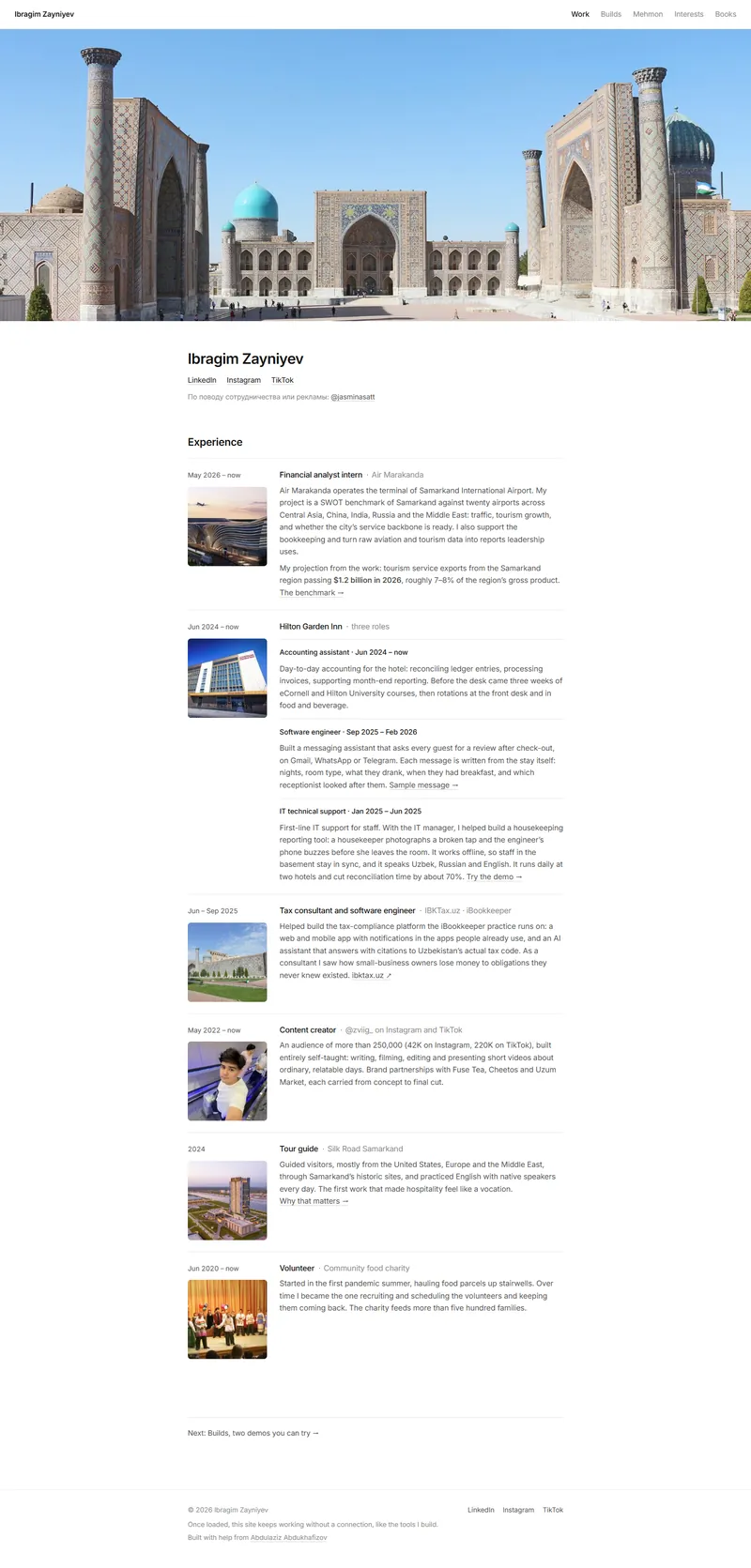
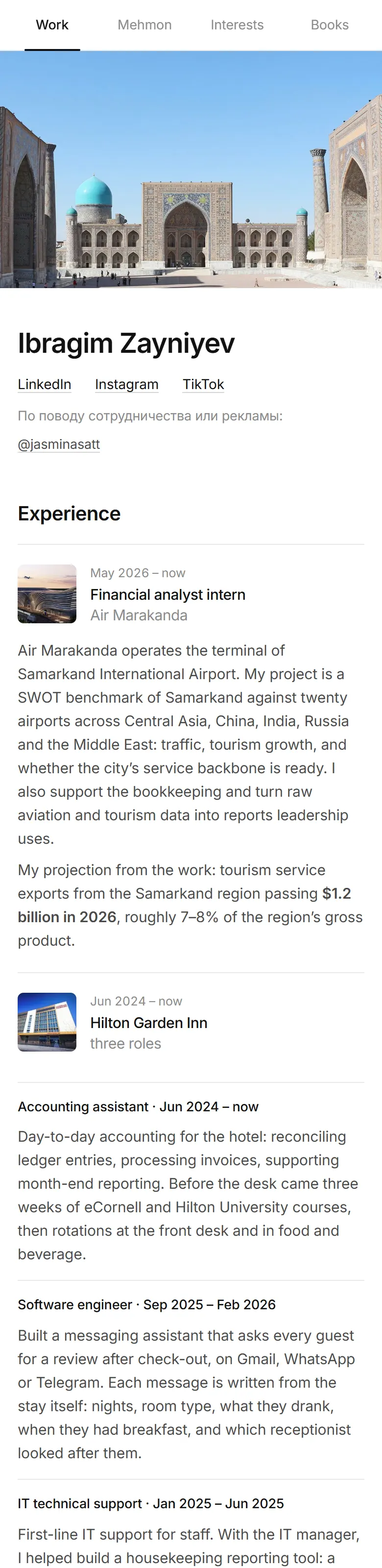
It starts with a record: your work, your writing, and the people who know it, gathered under your name.
Personal website
A home on the web for everything you have built: projects, writing, and a short account of who you are. Designed with you, and yours to keep.
Portfolio
Every project documented properly: the question, your role, the method, the result, and what you would do next.
LinkedIn
A professional profile that matches your website and your application, in your own words. LinkedIn requires members to be 16 or older.
Networking
How to write to a professor, a professional, or an admissions office, and how to follow up. Conversations that become relationships.
Mentor introductions
Introductions to mentors, alumni, and current students of leading universities, when you have a real question to ask.
Essays and activities
The same person on every page: your essays and activities tell the story your website shows. SAT preparation runs separately, in ScoreMarch Academy.
One person, everywhere. A reader who finds your website, your profile, and your application should meet the same person.
Essays & integrity
Your words. Our questions.
We never write a student’s essay. We ask the questions that find the story, then push each draft until it is unmistakably yours.
An essay is the one place an admissions reader hears you directly. If it is not your voice, it is not worth sending.
What we work on
How an essay becomes yours
Step 1: Excavate.
Long conversations and your dossier surface the moments, habits, and questions that made you.
Step 2: Choose.
Of everything true, we look for the story only you can tell, and the prompt it answers best.
Step 3: Draft.
You write the first draft. It is supposed to be rough.
Step 4: Question.
We ask, cut, and challenge, line by line, in comments, never in rewrites.
Step 5: Refine.
Draft after draft, until it sounds like you on your best day. Then we check that every sentence is true.
The ScoreMarch pledge
Five lines we hold ourselves to, in writing.
- We never write essays for students.
- We never invent or inflate activities.
- We never promise admission. No one honestly can.
- We publish only official scores.
- We tell you the truth about your chances.
ScoreMarch Group
Mentorship
Ask someone who’s already there.
Our mentors are alumni and current students of leading universities in thirteen countries, from the USA and Canada to Malaysia and Australia. They know the essays, the interviews, and the first semester from the inside.
The inside view.
What the classes, the city, and the first winter are really like.
A second reader.
Your plans, read by someone who made the same choice recently.
Practice.
Mock interviews with someone who has sat on your side of the table.
A wider circle.
Introductions across the network when your question needs someone else.
How matching works
We read your dossier.
Your interests, your field, and the countries on your list.
We match.
By field and by target country.
You meet.
With a question in hand, not small talk.
13countries in the mentor network
- USA
- Canada
- Italy
- Poland
- Egypt
- Qatar
- UAE
- India
- Malaysia
- China
- South Korea
- Australia
- Uzbekistan Universities in Samarkand and Tashkent
Want to know who? Ask us in consultation.
Meet the networkWhere our students go
Seven countries. Many rulebooks. One strategy.
The USA, South Korea, Italy, Israel, China, Qatar, and the UAE read applicants in different ways, on different calendars. Our students have been admitted in all seven.
Four Ivy League universities, liberal arts colleges such as Williams and Bowdoin, research universities such as Carnegie Mellon, and campuses across Asia, Europe, and the Middle East.
Rules change every cycle. Checked October 2026; we confirm each one for your year.

USA
Mentors hereAdmitted
- Columbia University New York
- University of Pennsylvania Philadelphia
- Cornell University Ithaca, New York
- Brown University Providence, Rhode Island
- Williams College Williamstown
- Carnegie Mellon University Pittsburgh
- Bowdoin College Brunswick
- The University of Alabama Tuscaloosa
- Reed College Portland, Oregon
- Macalester College Saint Paul
- Kenyon College Gambier
- University of Rochester Rochester
- Michigan State University East Lansing
- Stony Brook University (SUNY) Stony Brook
- University at Buffalo (SUNY) Buffalo
- University of Vermont Burlington
- Miami University Oxford, Ohio
- John Jay College of Criminal Justice (CUNY) New York
- How they read
- Holistic review: grades and course rigor, essays, activities, recommendations, and test scores where required, read together.
- The calendar
- Early Decision and Early Action deadlines around November 1, Regular Decision in early January, most decisions by early April, and a reply by May 1.
- What to prepare
- A personal statement and supplements, an activities list, teacher recommendations, transcripts with certified translations, and, where required, the SAT and an English test.
- Good to know
- Early Decision is binding. Most universities close applications at 11:59 p.m. in your own time zone, and a few set their own rule. We confirm each one, and aim to submit a day early.

South Korea
Mentors hereAdmitted
- Yonsei University Seoul
- Korea University Seoul
- How they read
- Document review comes first: school records, a personal statement and study plan, recommendations, and proof of language. Some programs add an interview: Yonsei’s Underwood International College does; Korea University does not.
- The calendar
- Two intakes, March and September. Students who finish school in May or June apply around March for September entry, or in August and September for the following March.
- What to prepare
- Korean-taught programs require a TOPIK level, and Korea University now asks most applicants for Level 3 or higher. English-taught programs ask for proof of English instead.
- Good to know
- At Underwood International College, SAT, ACT, A-Level, IB, or AP results are optional but strongly recommended.

Italy
Mentors hereAdmitted
- Temple University Rome Rome
- How they read
- Two paths. American universities in Italy, such as Temple University Rome, read applications much as US colleges do. Italian universities lean on grades and an admission test, and some, such as Bocconi, accept the SAT.
- The calendar
- Selective Italian universities often run an early session in the fall and a winter session that closes in January. Temple Rome sets its own dates.
- What to prepare
- For Italian universities, pre-enrollment through the national Universitaly portal, then a student visa. For 2027–28 degree courses, visa applications close on October 31, 2027.
- Good to know
- Regional need-based scholarships (the DSU system) are open to international students at public universities. They require a certified family-income statement called the ISEE Parificato.

Israel
Admitted
- Tel Aviv University Tel Aviv
- How they read
- Two paths. Degrees taught in Hebrew weigh school grades together with an entrance exam, and ask for proof of Hebrew. International programs taught in English set their own requirements.
- The calendar
- The academic year begins in October. Each program sets its own application dates, so check them early.
- What to prepare
- Transcripts and your diploma, with certified translations; test scores; and proof of English for programs taught in English, or of Hebrew for programs taught in Hebrew.
- Good to know
- Programs taught in Hebrew and in English have different requirements and dates. Decide early which one you are aiming for.

China
Mentors hereAdmitted
- Leading universities in China
- How they read
- Each university runs its own international admissions. The most selective add written exams or interviews.
- The calendar
- University rounds open between late September and January for September entry. Scholarship windows usually run from December to April.
- What to prepare
- Chinese-taught programs ask for an HSK level; English-taught programs ask for proof of English. Chinese Government Scholarship applicants for bachelor’s degrees now take a new assessment, the CSCA, unless their program is taught fully in English.
- Good to know
- Your university sends an admission notice and a JW201 or JW202 form. You need both for the X1 student visa.

Qatar and the UAE
Mentors hereAdmitted
- American universities in Qatar Doha
- American universities in the UAE United Arab Emirates
- How they read
- American campuses in the Gulf. Many read applications much as US colleges do: grades and course rigor, essays, activities, recommendations, and test scores where required. Each campus sets its own rules.
- The calendar
- In Doha’s Education City, early rounds close around November 1 and regular rounds in mid-January, with decisions by April 1. In the UAE, each university sets its own dates.
- What to prepare
- Transcripts, essays, recommendations, and proof of English, as for a US application, plus test scores where a campus requires them.
- Good to know
- Early rounds differ from campus to campus. Some are binding Early Decision, others non-binding Early Action, so read each campus’s rules before you choose.
Considering somewhere else? Our mentor network also reaches Canada, Poland, Egypt, India, Malaysia, Australia, and Uzbekistan. Ask us in consultation.
Draw your roadmapYour roadmap
Your march, month by month.
Choose your graduation year and where you are aiming, and we’ll draw a month-by-month plan you can start today. In consultation, we make it yours.
The roadmap is drawn in your browser, and JavaScript is off. Book a consultation, and we’ll draw it with you.
Your march appears here, month by month, from this month to your first day at university.
Questions
Admissions, plainly answered.
What parents ask, what students ask, and our straight answers.
No. Universities decide admission, and no one can honestly promise it. We commit to the work: a clear strategy, real experience, and essays in your own words. The only thing we guarantee in writing is an SAT score, through ScoreMarch Academy, with terms fixed in the contract before lessons begin.
You do, every word. We ask the questions that find the story, challenge every draft, and refine it with you, line by line. Our pledge is simple: we never write essays for students.
Admissions engagements are scoped and priced after your consultation, because no two students need the same work. The Academy has two fixed plans: Base guarantees 1350+ and Advanced guarantees 1450+, with terms fixed in the contract before lessons begin. We share the fees on request.
The earlier you start, the deeper the work can go. Three or four years before you finish school, there is time to build. Two years out is very workable. In the final year, we focus on strategy, essays, and applications. Whatever your year, the roadmap above shows what each month should hold.
Large global firms valued at $70 billion or more, in hospitality, aviation, airports, construction, software, and data centers. We don’t publish their names; we discuss them in consultation.
Our students go to 25+ universities in seven countries: Columbia University, the University of Pennsylvania, Cornell University, Brown University, Williams College, Carnegie Mellon University, Bowdoin College, Yonsei University, Korea University, The University of Alabama, Tel Aviv University, Reed College, Macalester College, Kenyon College, University of Rochester, Temple University Rome, Michigan State University, Stony Brook University (SUNY), University at Buffalo (SUNY), University of Vermont, Miami University, John Jay College of Criminal Justice (CUNY), leading universities in China, and American universities in Qatar and in the UAE.
The USA, South Korea, Italy, Israel, China, Qatar, and the UAE, where our students have been admitted. Our mentor network also reaches Canada, Poland, Egypt, India, Malaysia, Australia, and Uzbekistan. Ask us about other countries in consultation.
Your mentor is an alumnus or current student of a leading university, matched to your interests and target countries. You meet with a purpose: a question about a major, a university, an essay, or the first year abroad.
Yes. We are based in Samarkand, and we work online with students worldwide. Sessions are scheduled in Uzbekistan time (UTC+5), and the booking page shows them in yours.
You fill in the dossier: your school, activities, interests, and goals, in your own words. We read every line before we meet, so the first conversation starts with what matters. You leave with a clear next step.
Yes. Our program is well suited to families who value privacy. Your dossier, essays, and plans stay between your family and the people working with you: we never share them with universities, firms, or mentors without your permission, and results on this site show only a first name and last initial. The privacy notice has the details.
Still deciding?
Ask it in your consultationBegin
Start with who you are.
Fill in the dossier and choose a time. We’ll come to the first meeting already knowing you.
Prefer email? abdulaziz@nycmail.com